District Boundaries

Dear JCPS,

Hello, my name is MM. I am a freshman at Doss high school. In my civics class we are learning about integration and how it affects us as a person. So we were asked if we were for or against cross busing in Louisville, Kentucky and why we [felt that way].

I am for busing because I believe that we as a students should have the right to choose the school of our choice. By choosing the school that we wanted to go to it give us a chance to learn about the future goal that we have made for our self. It also gives the students opportunities to get along with students that are from different parts of the town or community. It can also give students opportunities to learn new skills from each other and about the places that they live in or what they do fun.

My second reason is that it give all the students a chance to go to schools in areas with more money. They can also meet students that are as skilled as them so they can give each other advice, support each other to do well in school and it will push them to work harder than before because they have the support of their friend.

My third reason is that it can raises test scores because me as a student try harder when I saw other students work hard. It also makes me keep on working and it can also help eliminate racism because without the busing we will have more students that are white in one high school and there will be more black students in a different school so if you are the only one white in that school it will make you feel like you don’t belong in that school because how you look.

To change this problem I would like to give you one way to make the busing better. My plan is to add more busing in a school so the bus driver don’t have to worry about being late for the other school and the students will not be late to their class.

Sincerely,

MM

Dear JCPS,

My name is J. S., I am a student attending Doss High School. I am writing to explain my reasoning why busing in JCPS should continue. JCPS busing program is perfectly fine the way it is. Busing is a way many kids are having fun with their friends, at compound children at seeing and meeting people they like and socialize with. Even the wait on compound busing is fun for others, for example gives some of them a chance to finish work if they didn’t feel like doing work as soon as they got home.

If JCPS were to change the busing it wouldn’t encourage lots of children to attend school. Students wouldn’t want to go to school that does not help them achieve their biggest goal. A lot of parents tell their child to apply to a certain school they think would give them a better opportunity that can’t reach at their home school. Students base the school they want to attend on their grade point average, programs, activities and etc. All schools don’t have the other programs and activates that most schools have.

There are a lot of CONS that will be faced if busing stops. There wouldn’t be a lot of kids in JCPS, parents would be forced to send their child far away from home for a better education. More children would go to their neighborhood school. Families with lots of money go to private schools because they don’t like people in certain areas (sad but true). Students would have to car ride which burns more fossil fuel and not all parents have money for gas.
With busing it will gives students opportunities to go to school in areas with money. Students will have the opportunity to go to school with people who are unlike/different from them. Sending students to their applied school will raise test scores by putting them in their appropriate class. Busing provides equal opportunity in public education. Also it eliminates a lot of racism.

Busing stopping will cause a lot of history to most likely repeat itself. More schools will get over populated with children having to go to their neighborhood school. More states who stop busing will get more segregated. In neighborhoods more blacks live in a certain part than whites which would cause segregation. Students wouldn’t feel comfortable in a school mostly filled with just one race and will leave. Eventually residents in JCPS will get mad and busing would have to start again.

Sincerely,
JS

Dear JCPS,

My name is S. P. and I am currently in Mrs. Weaver’s Exploring Civics class at Doss high school. Right now in class we are going over integration, segregation, and busing. We have been doing research by reading articles and watching videos to see if we think busing is a good thing or a bad thing for the people. I think busing is a good thing and I would like you to keep busing for as long as possible.

My first reason why busing is good is if we didn’t have busing people would [have to] move to the nicer neighborhoods so their child can get the better education. A child would get a better education from a higher [income] school because what I have noticed is that kids that have parents with lots of money are more likely to behave, get good grades, and allow the teachers to teach more than a poor kid would. So my point is if you are in a higher [income] school area most of the kids are more engaged and behave than the lower [income] schools so it would be easier to learn in the nicer neighborhood schools.

My second point is Detroit and Louisville. Detroit does not do busing and Louisville does. Now the cities are almost identical racially and socially. Now Detroit who does not do busing, has a higher crime rate and there vacancy is higher than Louisville’s. So is it a coincidence, because I don’t think it is.

Another reason people think busing is bad is it keeps students from playing sports. Well I disagree with this point because my friend rides a bus for an hour and still wrestles. Every day the school gives him a TARC ticket to get home. So if they want to play sports they can.

So these are some of my reasons why I think busing is good. I hope you agree with my letter. So I ask you to keep busing for the better of the people.

S.P.

Dear JCPS,

My name is J.M., a student at Doss High School, and I am for busing. Busing started in the 1970’s to ensure that schools were not segregated. Segregation in public schools ended in 1954 due to the Supreme Court decision, Brown v. Board of Education. Busing gives students the opportunities to go to schools in areas with more money.

The more money a school has, the better education for the children. There would be better textbooks and technology. Not all schools have lots of money, but with busing it gives students a way to get to a school outside of their neighborhood. Studies show that the more textbooks and technology a school has, there is a better education for students.

If busing were to end, some children’s test scores may drop. Most neighborhood schools are not as good as schools that requires busing, educational wise. Some may argue that students are on the bus for too long. But getting a better education is more important than how long a child is on the bus.

I believe that if a student is on a bus for too long they should spend their time wisely. What I mean by that is, if they have homework, they can complete that on the bus. If they are tired, they can take their afternoon nap on the bus. If this is done on the bus, children would not have much to do when they return home from school.

If busing ends, that would basically be segregation all over again. There are certain neighborhoods that are separated by races. If everyone had to go to their Neighborhood schools, the school would consist of all one race. Busing helps prevent racism, because most schools are now mixed with different races. I hope you make the right decision and keep busing.

J.M.

Dear JCPS,

My name is A.B. and I am a freshman at Doss High school. I am writing this letter to tell you my view on busing. I think that we should keep busing, because it has many up-sides. Also there are ways we can fix the situation to improve academics.

One of the biggest problems with busing is the long rides. Many students are on the bus for about 1-2 hour a day. I know this because I am one of those students. Do I think it is a long ride? Yes but, it doesn’t mess with any of my after school activities or academics. Busing also mess with the amount of each race there is at a school, but some areas are going to be majority one race no matter what because of the neighborhoods. Stopping busing won’t fix this problem.

If we keep busing, it eliminates racism and students get a better education. The fact that students are coming from completely different areas means that they are more likely to come from completely different backgrounds. It also gives students opportunities to go to school in an area with more money than the neighborhood they live in. The purpose of busing is to desegregate schools. Desegregate means to eliminate segregation which would bring race closer. Bringing different races together is especially important in this day and age with the new president.

We need to keep busing for many reasons. One being it helps desegregate. Another is the opportunities it gives students. Also it helps improve academics. There are many cons but the pros outweigh them.

Doss High Student,
A.B.

Dear JCPS,

I’m a student at Doss High and I think that busing is a good idea for JCPS students. This is because it gives some students a chance to see what they haven’t seen or experienced before. I think that there are some things about it that kind of makes people rethink because of the long bus ride from home to school, but other than that, there are great advantages.

For schools, it would do a lot. It would raise the schools test scores like ACT and SAT tests to let parents think about sending their child to the school. Either resides or school of choice, it will be a good reflection. Busing would also balance out the race in the school because there are people coming from all parts of Louisville to go to a school. This will make it a nicer environment for all students to see other races they probably haven’t seen or been around that much before. This also makes parents think about how open that school is so there isn’t any racism going on or kids being mean to each other about their race.

Another advantage is that it gives students more of an opportunity to be in other programs that other schools might not have. Like our school has the Class Act Credit Union, there aren’t that many schools with that, so kids can learn about how to take care of money and prepare for the future. The programs are either to have something to do, or prepare for the future. Nursing programs aren’t in some schools, but if kids are being bused to other schools, they have a chance at it. The other schools that kids are being bused too might have more money and more updated things like computers, etc. This can make students want to learn a lot more if they have something that they’re used to, or new to. This might also want kids to think about college because if you’re in a nursing program, this can make kids want to go to medical school, or make up their mind about what they want to do and experience things earlier.

So, if you left the busing where it is, then the students would have a better opportunity to see the things that they have never experienced before and can benefit them for the future. This will also let them go to a school with more money and more programs that could help with their future. It would help the school by raising test scores and racism would not be around in the school, this would make it nicer and help people get along better. The students would also have more experience in computers and other things. That’s why I think busing would be successful for JCPS.

Sincerely,
M.E.

Dear JCPS,

Hey! My name is K.M. and I am a 14 year old Doss High School student. I want to talk to you about JCPS busing. I’m not for busing because nobody wants their kids on an hour bus ride. Like for example racial integration is worthy goal, and busing is an easy mean to achieving that goal. Children in higher socioeconomic areas naturally have more opportunities than children who do not. Putting children in schools that’s in their neighborhood is not a good idea, some neighborhoods is mostly blacks and others is mostly white and putting them all in one school is going to cause segregation.

Far away schools is not working for the parents is either, parents cannot be involved in school if it is too far from their home. Parents are forced to send their kids far away from home for a good education.

Busing was started in the 1970’s to ensure that schools were not all black or all white. African American’s lived in the west end, while whites lived in areas like St. Matthews or the country. The whites would have a long ride to and from school every day like an hour or 2 ride. The west end kids would go to school far from where they live to, like some might go to school far like Seneca.

Busing causes white flight where families move their children from public city schools to private and suburban institutions. They put all whites inside the same school that causes more and more fights same with African American’s it’s going to cause more and more fights.

It also gives students the opportunities to go to schools in areas with more money. On the other hand busing too costly for school districts that must purchase the buses to establish the program. Example staying after school and buses have to take you home and you live far away that is going to cost a lot of money.

Sincerely, KM

Dear JCPS,

I’m L’R B and I attend Doss High School. My opinion on busing is that it should continue. I bring this up because my Civics class gave me a task to write a letter to JCPS arguing for or against busing using the evidence I found from my research. I think busing should continue because it helps racial integration, it gives students opportunities to go to schools in areas with a better environment, and it eliminates racism. I will come up with a better student plan to help busing continue.

Busing brings great experience to lots of students. You meet people of all kinds teaching you that a difference in race doesn’t matter. Also busing shows a student in a poor environment a look at how it is to live well. Students from different races get to learn from each other. It brings everyone together.
If I could solve the problems people have with busing I would change a lot. First thing I would do would be change the school time to later hour so students have more time to be picked up. I would also add community schools for parents who want their children close. Students who have trouble getting along, I would have a counseling for them to get better. If the student likes the counseling I would continue, if not ill switch their school.

Overall there’s a lot of good things busing allows us to do. I’ll say the bad opinions against busing aren’t good enough to stop it. Busing is wonderful for everyone and lots of people enjoy it, let’s not repeat history by basically segregating schools. I hope this letter gives you a view on how some students feel.

Thank you,
L’R B

Magnet “programs” will not be protected under this new law. Many families will lose out on choice.

Be sure to see where your board members stood on this discussion prior to the unanimous vote to support local control over student assignment (opposition to HB151).

Read Chris Kolb’s full speech here.

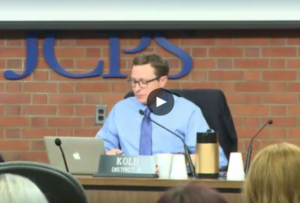
Chris Kolb speaks on the detrimental impacts of HB151 (16:00 mark).

Remarks on HB151
Dr. Chris Kolb
JCPS Board of Education Special Called Meeting
Wednesday, March 1, 2017

I’d like to share an email I got from one of my constituents this morning.

One of the reasons my family returned to Louisville to raise our children is JCPS’s vibrant system of magnet programs. My daughter’s middle school will prepare her for wherever she wants to go next—she’ll have the academic preparation if she wants to focus on language at Atherton’s IB program, she’ll have arts experience if she wants to pursue art at YPAS or Manual; if she’s interested in learning more about law and politics, Seneca, with its legal work magnet, is her resides school. What a great selection we have! Thanks to JCPS our city is full of people who want to venture into new-to-us areas. My children go to school with kids who have similar life experiences and kids who don’t. Thanks to JCPS families have been allowed to choose the educational approaches that will best help them succeed. Please don’t allow Frankfort’s legislators limit my kids’ friendships to those we already have met. Don’t send us back to our isolated islands, segregated again.

Thirty-eight days before I was born, white pro-segregation rioters in Louisville burned school buses, threw rocks, and attacked police. The Ku Klux Klan organized and led several such riots in Louisville, all in the name of “neighborhood schools.” Many in the all-white crowds held Confederate flags while they threatened, harassed, and assaulted black children.

But our city persisted, led by the courage of African American parents and children. And thanks to their sacrifices, I was able to attend high-quality, integrated public schools in Louisville, as have my children. Thanks to their bravery, I have lifelong friendships with people from all over the city I never would have met. I am extremely grateful for their sacrifice and struggle.

But now we are facing the very real possibility that the hard-won progress of the last 42 years will be undone through government overreach into local affairs by state legislators, the overwhelming majority of whom do not live in our community.

House Bill 151 threatens a core principle of our democracy: local control of our school system. It’s curious that many of the lawmakers who just spent eight years consistently complaining about what they perceived to be federal overreach of the Obama Administration are now some of the most vocal supporters of state overreach into local issues.

The voters of Jefferson County elected the seven of us you see before you. I would ask our state legislators to remember that seven of the fourteen candidates for the JCPS Board of Education in 2012 ran on a platform of “neighborhood schools.” They were all defeated, most of them handily. The voters and families of Jefferson County have spoken on this issue time and time again and the state should respect the democratic will of Jefferson County voters. It is simply not acceptable for state legislators with little or no experience in Jefferson County to undermine the democratic will of Jefferson County voters in dictating where our kids can and can’t go to school.

In addition, there are several reasons why HB151 will have significant negative impacts on our families. It will lead to less choice, less predictability, less equity, and wider achievement gaps. These are not debatable points. This is what data, evidence, and logic tell us will happen.

But on top of all that, HB151 will not even accomplish what it sets out to do. For instance, if HB151 is implemented, the closest school with guaranteed openings for some students who currently attend Shawnee will be Waggener. Instead of a 1.9 mile walk or a 19-minute bus ride to Shawnee to participate in after-school activities, these students will endure an hour and a half ride on two different TARC buses to do so. While Waggener is over eight times farther away than Shawnee, Waggener will be the closest “neighborhood school” for many kids.

Families who live as little as 0.8 miles away from King Elementary will not be guaranteed admittance, nor will families living 0.73 miles from the Academy at Shawnee, 0.9 miles from Frayser, 0.84 miles from Rutherford, or 2.6 miles from Carrithers. And these boundaries will change every… single… year. The only way to guarantee you will get into your neighborhood school is to move, literally, across the street from it. On top of the dozens of other reasons HB151 is unwise, HB151 is not even a neighborhood schools bill.

In closing, I want to share something from an article in the Atlantic magazine in 2015 comparing Louisville to Detroit. In 1974, Detroit largely abandoned school desegregation efforts.

By 2000, … the average black Detroit student went to school with less than two percent white students, while in Louisville, the average black student went to a school that was half white. In 2011, 62 percent of Louisville fourth-grade students scored at or above basic levels for math; only 31 percent of Detroit students did.

As researcher Gary Orfield states,

Go to Louisville, go to Detroit they’re just different planets today. … These are places that had the same percentage of black people, they had the same percentage of poor people, they were almost identical, racially and socially. And Louisville is thriving. And Detroit’s collapsed.

HB151 is a threat to local democracy, to school choice, to student achievement, to a more integrated community, and to the economic livelihood and the very future of our city itself. Decisions with this level of impact on our community must be left to the people who actually live here, pay taxes here, and who vote for School Board here.

Thank you.