Archives

All posts by jcpswatch

This is a message we received from a Louisville Catholic school parent:

“The teachers all thought surely the Archdiocese would listen to the Governor’s recommendation. When the Archdiocese announced that they would not be following the Governor’s recommendation, that’s when teachers started reaching out to me.

These are the things I’m most concerned about:

1. Teachers are afraid of losing their jobs, and are not being offered the opportunity to teach remotely instead of in-person. They are afraid of speaking up and talking to their peers for fear of retaliation for organizing as a “union.” Continue Reading


After watching this week’s episode of Save Our Schools with Dear JCPS

  1. Complete the survey to let district leaders know your thoughts on safely returning to in-person school.
  2. Sign the pledge to stand with JCPS Grassroots Organizations as they stand up for our most vulnerable students.
  3. Join KEU to stay up-to-date with the latest actions and information related to state and national efforts to advocate for students, educators and our community!
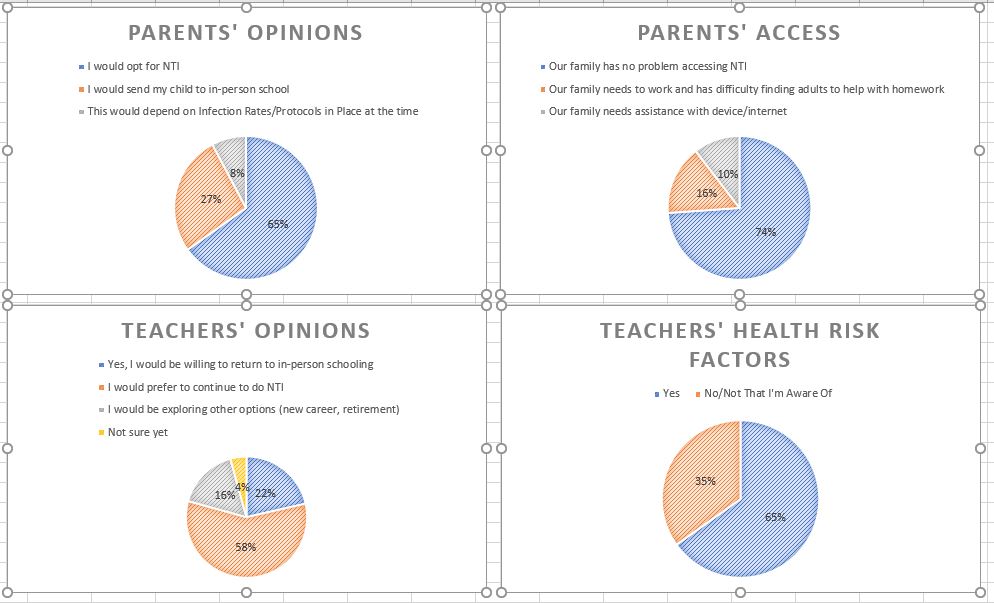
Survey Results as of 2 PM July 21, 2020. 200 Respondents.

Dear JCPS Superintendent and Board of Education,

Tonight, as you weigh difficult, critical decisions regarding when and how to safely return to in-person schooling, we thank you for keeping the health and safety of our students, their families and their teachers and all who work in the service of their care as your primary concern.

No doubt you’ve received numerous and varied points of data regarding this topic. Due to the extra layer of anonymity Dear JCPS provides, combined with our group’s intentional efforts to seek input from impacted community members, we believe that we bring a different perspective to the table.

We hope that you find useful the information reflected in our recent survey results revealing teachers’ willingness and ability to return to in-person schooling. May this feedback, along with parents’ needs, concerns and barriers also captured in the survey, help guide your decision making as you begin to phase-in, pair and prioritize students, adults and classrooms. We hope that you will take a moment to read some of the individual concerns that were shared with us by parents, teachers, staff and administrators, as well, which can be found here:

Survey Responses

Later this evening, we will be uploading the most recent episode of Save Our Schools with Dear JCPS. In it, we discuss the purpose of the survey, some surprise revelations regarding the proposed tax increase (including the overlooked West-End, black- and black-allied organizations’ stances on it and efforts underway to prevent them from being silenced), a new program we are proud to launch called Dear JCPS Teachable Moments, and more. We hope you will give it a watch, review the comments, and provide us with your feedback.

Thank you again for your hard work and bravery to make difficult decisions during these uncertain times.

This is a DRAFT of our legislative priorities for 2020. We want your input! Please help us rank them and provide examples of each of the categories listed below. Suggested edits and additions also welcome.

ACHIEVING EDUCATIONAL JUSTICE in JCPS “with E’S”

FROM OUR JCPS BOARD MEMBERS & SUPERINTENDENT, we demand:

  • EVIDENCE-BASED education practices
  • Realistic EXPECTATIONS
  • EXPERIENCED teachers, staff and leaders
  • EMPOWERED students and advocates
  • EQUITABLE funding, resources and access
  • ENRICHING experiences
  • ENGAGING, culturally competent curriculum
  • Nurturing and safe learning ENVIRONMENTS
  • EXTERNAL community supports
  • Supportive and meaningful EVALUATIONS

FROM OUR LOCAL AND STATE LEADERS, we demand:

  • Accountability and Transparency
  • Authentic Education Reform and
  • #FullyFundED Public Schools

For EVERYONE!

To submit your feedback, click here.

Dear School Board,

Very concerned and hurt how Dann C Byck is looking.
It needs a whole new make over.
The school looks so bad that the children have nothing to look forward to. We want our children to have Hope. They can’t at that school.
Every door needs to be painted, the windows look bad and curtains are falling down.
The principal should be ashamed of herself knowing that her salary looks good. But her school looks bad.
Please Help our school. I am hurt
Thanks, 
Vanessa Goodwin

Dear Anonymous,

Iroquois is not on fire. You are! Bring your buckets of water if that’s what you think because you’re a liar with your pants on fire.

Our school isn’t perfect. You won’t find one that is. Sometimes we have above average challenges and at all times we have an above average staff to meet those challenges. If you’re actually on our staff, Anonymous, you are the weakest link. Transfer season opens in three months and I’ll do your paperwork for you, will gladly help you pack, and hold the door for your tired behind to leave quickly, quietly, and reverently.

You’ve attacked my wonderful principal, our dedicated counselors, our committed staff (amongst whom are proud alumni), and worst of all, our students. You see, my own children, scores of extended family, and all of my godchildren were educated at Iroquois. My son was valedictorian and graduated magna from UofL. Professors couldn’t believe he’d graduated from Iroquois. I could. It’s a great school where, without regret, I’ve dedicated 20 years of my life. I’ve never had a bad day there. Challenges? Yes. I signed up for public school and everything that comes with it. I love my school.

What peeves me about you, Anonymous, is that you choose to hide behind your words. I would not normally give such messiness the time of day, but you attacked something dear to me—my school. You attacked someone dear to me—my colleagues and students.

Stay comfortable in your misery, sad person, because what’s said in the dark will come to the light. But before you post again, let me go low for a moment. According to my writing scoring rubric, I would like for you to work on the following—this one’s on me:

1. Organization is key. Group your rambling thoughts coherently.
2. Though we could understand your miserable letter, transition words would make it a smoother read. If you’re going to insult us, at least smooth out the wrinkles in your pig’s ear.
3. Ramp up your vocabulary to better represent the best of your thinking—unless your vocabulary as presented actually does represent your level of thinking. In that case, sign up for Iroquois where we will teach you to strengthen, well, everything you’ve written.
4. Use concrete examples and skillfully interweave them throughout your writing. Tie in example, explanation, etc. Give your audience a full picture to prove you know what you are writing about. Try not to “list”.
5. Be truthful in your writing. Authenticity is also key.
6. Own your writing with a closing that includes your signature and printed name.

If you are amongst us at the school, you have lost the respect and trust of your colleagues. Maybe you need a hug. Maybe you need Jesus. I don’t know. But what I do know is, while our school is not for every teacher, our school is for every student. We value Iroquois and, like any commitment, we take the ups and the downs with grace. And for those of us who are committed, and I’m included in that number, it has been and it remains a distinct pleasure to work for everything Iroquois.

Don’t ever write another letter like that again.

Aletha Fields
(c) Aletha Fields, 2019

A teacher sent us this additional background on the cell phone issue.

Dear JCPS,
 
Our cell phone policy is contradictory and ineffective. The directive at the beginning of the school year was that cell phones were completely banned between 7:30 and 2:20. They were not allowed in hallways during passing, not allowed at lunch, not allowed in classrooms. Teachers cannot make exceptions for educational purposes.

If students are on their cell phones, we are supposed to warn them that they are not allowed to be on their cell phones. We are to warn them even if we warned them every day for the last month. If they continue to use their cell phones, we can call for a staff member to come get the student. The student gets to choose whether they want to give up their phone for the rest of the day, or keep their phone and go to ISAP. We must also call the student’s parent if this happens.
 
There are a number of loopholes in this system. First, it’s tough to keep track of who you have given warnings to today and who you haven’t. It takes extra time out of class to manage that. If a kid gets on their phone anyway (and they usually do, since there’s no effective consequence), then we have to stop class to call for someone to come to my room. We then have to deal with the disruption to class that will cause. Students have learned that the last 5-10 minutes of every class is a free-for-all because there isn’t enough time for someone to come get their phone before the next class. The last class period of the day is the Wild West because worst case scenario if they take your phone, you’ll get it back in a few minutes anyway.
 
We are supposed to enforce the policy in the hallways during passing. The way this works is the kids walk down the hall with their cell phones in hand and ear buds in their ears. Teachers tell them to put them away. Half of them put their phone down until they’re a few steps past the teacher and then get right back on it. The other half ignore the teachers altogether. Either way, there will be no administration enforcement so the exercise serves no purpose except making teachers look futile and powerless.
 
The day after the incident with the teacher at Iroquois, I kept track of my class with the worst phone issues. Students were working on group projects. At the beginning of class, I told students to put their phones away (this is how I have to start every class, since there are usually quite a few in use after the bell despite the ban). I gave the class instructions on what they should be doing, and told them that anything requiring technology should be done on the chromebooks I had checked out for their use. I again repeated that students should not have cell phones out for any reason (it’s November but I still have to explicitly state this classroom expectation that has not changed since August). Within the first five minutes, I had to warn EIGHT students to put away their cell phones. By the end of class, TWELVE phones had to be confiscated in a class of 27 students.
 
The next day, it starts all over again. The same kids who were on their phones the day before have to be told again that it’s against the rules, and to put their phones away.
 
Every day, they get angry and offended by being told to put their phones away. The warnings just tell a kid how long he can stay on his phone before the possibility of a minor consequence might occur. It’s exhausting to keep up with. But God forbid you don’t give a warning to that kid that you’ve had to tell to put their phone away every school day for the past four months, because if you don’t then the kid, the parent, and admin will raise hell with you.
 
It doesn’t matter how engaging a lesson is, the kids wouldn’t notice because they’re blasting their music and messaging their friends on snapchat. Every time I tell a kid to put their phone away, every time I call to have their phone taken, I know I’m running the risk of disrupting my class, or setting up a violent reaction. Best case scenario, I’m losing precious minutes of instructional time pursuing a policy that is not working.
 
I don’t have the answers, but this ain’t it.

Signed,
Anonymous HS Teacher